
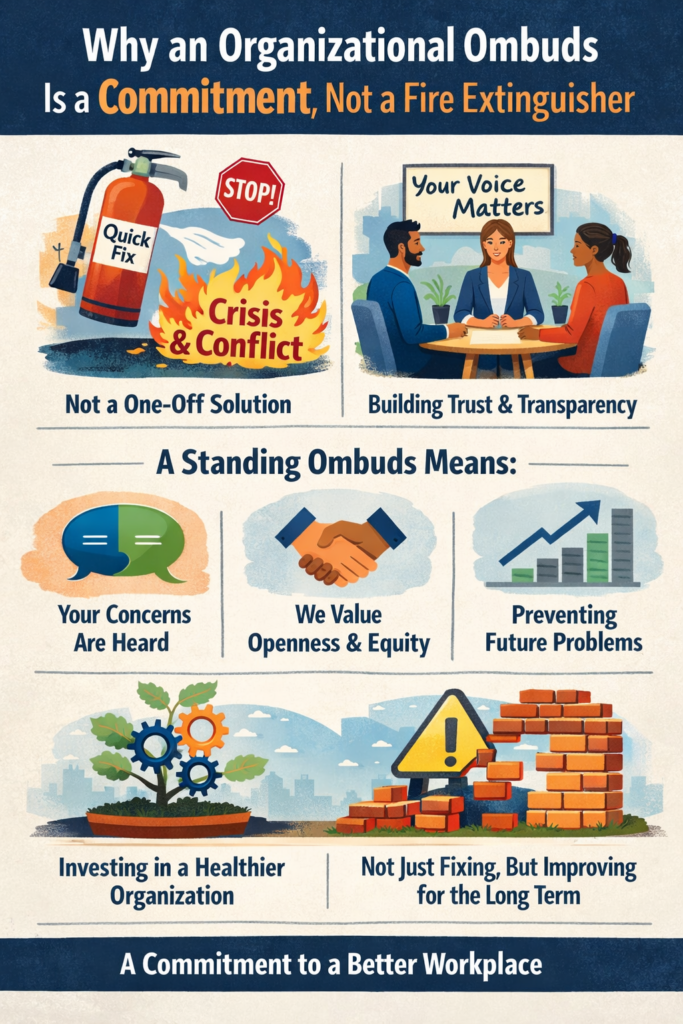
What You Can’t Say But I Can: Episode 5 Why an Organizational Ombuds Is a Commitment to Culture, Not a Fire Extinguisher
Organizations often call for help when things feel stuck. A complaint lands on the desk. A conflict escalates. Morale dips, and someone says, “We should bring in an ombuds.” The instinct is understandable. It is also backward.
An organizational ombuds is not a one-off solution to a specific problem. Treating the role that way misses its value and, frankly, undermines its credibility from day one. An ombuds works best when the organization makes a visible, sustained commitment to transparency, openness, and listening—long before a crisis shows up on the calendar.
At its core, an ombuds signals to employees that their voice matters here. When people know there is a place to raise concerns, test ideas, and talk through issues without fear of retaliation, behavior changes. Conversations happen earlier. Problems surface when they are still manageable. Leaders hear what they would not hear otherwise.
An effective ombuds does not exist to confirm leadership’s assumptions or validate existing decisions. The role exists to surface patterns, tensions, and blind spots that formal reporting channels rarely capture. When employees trust the ombuds process, they speak more candidly. That trust develops over time, through consistency and clarity about the ombuds’ role, boundaries, and independence.
This is why bringing in an ombuds “to deal with this one issue” tends to backfire. Employees read the situation quickly. If the ombuds appears during a crisis and disappears once leadership feels better, the message is clear: speaking up is tolerated only when it is convenient. That erodes trust faster than doing nothing.
A standing ombuds program communicates something different. It says the organization values feedback even when it is inconvenient. It says leadership understands that not all concerns fit neatly into HR policies or formal grievance processes. It says there is room for nuance, context, and human judgment.
That commitment shows up in culture. Organizations with embedded ombuds programs tend to see fewer escalations because people have a place to talk things through before positions harden. They see improved retention because employees feel heard, even when outcomes are not perfect. They also gain better data about themes and trends that help leaders make informed decisions.
There is also an equity dimension. Not every employee is comfortable going to a supervisor, HR, or legal. Power dynamics are real. So are fears about being labeled “difficult” or “not a team player.” An ombuds offers an alternative entry point—one that levels the field and acknowledges that different people need different ways to speak up.
Leaders sometimes worry that an ombuds will invite complaints or create more problems. In practice, the opposite tends to happen. Issues already exist. An ombuds does not invent them; it makes them visible. Visibility enables organizations to address root causes rather than manage recurring symptoms.
Think of an ombuds as infrastructure. Like good governance or sound financial controls, its value compounds over time. You do not install it because something went wrong last quarter. You install it because you want a healthier organization next year and five years from now.
That said, if things have already blown up, it is not too late for an ombuds. Bringing one in after a crisis can still matter, as long as the message is clear: this is not about damage control, blame, or closing out a chapter as fast as possible. It is about signaling that the organization wants things to be different going forward, and is willing to invest in structures that prevent the same problems from repeating under a different name.
Sarah Hannah-Spurlock is a Florida Supreme Court-certified Circuit, County, and Family mediator with over 25 years of experience managing in local government.